
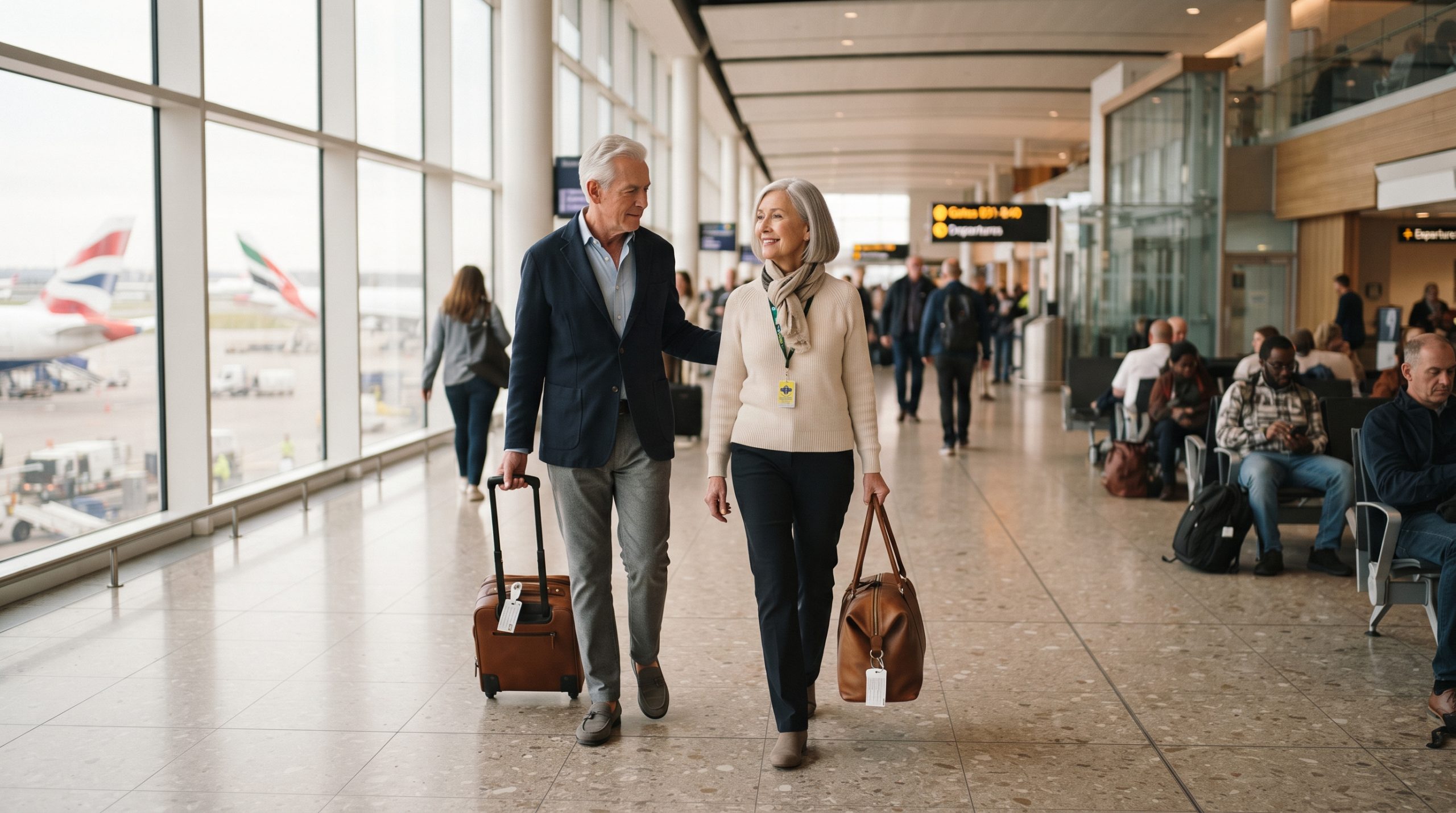
Airports can be stressful for almost anyone. They are busy, unfamiliar and filled with crowds, announcements, security procedures and unexpected changes.
For someone living with Alzheimer’s or another hidden disability, those everyday parts of air travel can feel especially overwhelming. Unfamiliar surroundings, interactions with strangers, long lines and changes in routine may increase confusion or agitation before the journey has even truly begun.
The good news is that there are services available that can make navigating the airport easier. With a little preparation, families and caregivers can create a calmer experience and reduce some of the uncertainty that comes with air travel.
Start With the Airline
One of the first steps should happen before you ever arrive at the airport.
When booking your flights, contact the airline and ask about its accessibility or special-assistance services. Depending on your traveler’s needs, wheelchair assistance can be particularly helpful — even when walking itself isn’t the primary concern.
Airport terminals can involve long distances, crowded spaces and multiple transitions between check-in, security and the gate. Having assistance can provide additional structure while reducing some of the physical and mental demands of navigating the airport.
You do not need to share every detail of someone’s medical condition when requesting assistance. Instead, explain the type of assistance the traveler needs and ask how the airline handles the process at your departure, connection and arrival airports.
Policies and procedures vary by airline, so ask questions ahead of time. Find out where you should go when you arrive, how assistance is requested at connecting airports and what to expect once you reach your destination.
Consider the Hidden Disabilities Sunflower
One resource families may not know about is the Hidden Disabilities Sunflower.
The Sunflower is a discreet way for someone to indicate that they have a non-visible disability and may need additional time, patience, understanding or assistance.
For a traveler living with Alzheimer’s, that simple visual cue can be valuable because their disability may not be immediately apparent to airport employees.
The program is recognized by participating airports, airlines and organizations around the world. Some participating locations provide Sunflower lanyards or other Sunflower products free of charge, while official products can also be purchased in advance.
Because participation varies, check whether the airports and airlines on your itinerary recognize the program before traveling.
Learn more about the Hidden Disabilities Sunflower
Request TSA Cares Assistance
For travel through U.S. airport security, families should also know about TSA Cares.
TSA Cares provides additional assistance to travelers with disabilities, medical conditions and other circumstances that may affect the security-screening process. Travelers who need additional help can request assistance from a Passenger Support Specialist, a TSA officer with specialized training in assisting passengers who may require additional support.
TSA recommends contacting TSA Cares at least 72 hours before travel when requesting passenger support. The TSA Cares helpline is (855) 787-2227.
This is something I would arrange before departure rather than waiting until you arrive at the security checkpoint. Knowing that assistance has been requested can remove one more unknown from the day of travel.
Learn more or request assistance through TSA Cares
Give Yourself More Time Than You Think You Need
When traveling with someone who may become overwhelmed or confused, rushing can make an already stressful situation more difficult.
Arriving early gives you room to move at a comfortable pace, handle an unexpected line or change and take a break when needed. It also means that if your family member needs a few extra minutes to understand what is happening or transition from one part of the airport to another, you don’t have the added pressure of watching the clock.
The goal isn’t to spend unnecessary hours in the terminal. It’s to create enough breathing room that you aren’t forced to rush someone who needs more time.
Consider an Airport Lounge
Airport lounges aren’t free, but in the right circumstances, I believe they can be well worth the additional expense.
A quieter environment away from a crowded gate can make a meaningful difference for someone who becomes overwhelmed by noise, crowds and constant activity. Depending on the lounge, you’ll typically find more comfortable seating, refreshments, restrooms and a calmer place to wait until it is time to board.
Not every airport or itinerary makes lounge access practical, and lounge admission rules vary. But when I’m looking at an itinerary for a family traveling with someone who has Alzheimer’s or another hidden disability, it is an option worth considering.
Sometimes the best travel upgrade isn’t about luxury.
It’s about comfort.
Create a Calmer Journey Before You Leave Home
When traveling with someone living with Alzheimer’s, small details can have an outsized impact.
Choose flight times that work well with their normal routine whenever possible. Consider nonstop flights rather than connections when the itinerary allows. Keep medications, identification and essential items together and easily accessible. Bring familiar snacks or personal items that provide comfort, and make sure important travel information is also available to the caregiver.
Most importantly, build flexibility into the day.
A traveler may need a few extra minutes. They may need to sit somewhere quiet. A familiar routine may suddenly become more important than the original schedule. Giving yourself permission to adjust can help keep a difficult moment from becoming an overwhelming one.
Travel May Look Different — But It Can Still Be Meaningful
Traveling with Alzheimer’s or another hidden disability requires more preparation, patience and flexibility. That doesn’t automatically mean meaningful travel has to stop.
It may simply need to look different.
The right flight schedule, airport assistance, TSA support, a Sunflower lanyard, a quieter place to wait and plenty of extra time can all help create a more manageable journey.
And that is something I believe is worth planning for.
At Serreis Travel, thoughtful travel planning isn’t only about choosing the right ship, destination or itinerary. It’s also about considering the people who are taking the journey — their comfort, their needs and the details that can help them travel with greater confidence.
Alzheimer’s is also a cause that is close to our hearts at Serreis Travel. We are proud to support the Alzheimer’s Association as part of our commitment to helping create a future with more answers, more support and more meaningful moments together.
Learn more about Our Cause and why it matters to us.
Because some of the most important parts of a journey aren’t the places we visit.
They’re the memories we have the opportunity to make together.
Travel assistance programs, airport participation and airline procedures can change. Always confirm current policies directly with your airline, airport and TSA before traveling.